
















Athletics: Temperature Guidelines
The extreme heat and cold in our region is a concern to the health and safety of our students and staff members. Heat and cold injuries cannot always be prevented, but with cooperation between the Athletic Trainers and coaching staff heat and cold-related illnesses can be minimized.
The following temperature guidelines have been established in order to provide a safe and healthy environment for students participating in outdoor activities in Judson ISD. The listed temperatures, WBGT indexes, and wind-chill factors are designated figures for terminating and/or modifying outdoor activities including High School and Middle School athletic practices and games.
Exposure duration and frequency of breaks should be modified as the temperatures approach the listed recommendations. It is the responsibility of each Athletic Trainer and coach to ensure these guidelines are being followed.
In 2026, the UIL approved Wet Bulb Globe Temperature (WBGT) as the required forecast measurement to be used to monitor environmental conditions during outdoor physical activities. WBGT estimates the effect of temperature, relative humidity, wind speed, and solar radiation using a combination of temperatures from three thermometers.
The American College of Sports Medicine has recommended WBGT guidelines that dictate modifications in activity (work: rest ratios, hydration breaks, equipment worn, length of practice) at given WBGT temperatures to prevent Exertional Heat Stroke. The below table represents modified guidelines from the American College of Sports Medicine regarding:
The scheduling of practices at appropriate WBGT levels
The ratio of workout time to time allotted for rest and hydration at various WBGT levels
The WBGT levels at which activities should be terminated
It is required that UIL member schools utilize WBGT to monitor practice and workout conditions and alter practices as outlined in the chart below based on recommendations from the American College of Sports Medicine.
WET BULB GLOBE TEMPERATURE: Updated From UIL for 2026-2027 : heat recommendations is a requirement for all outdoor UIL activities held in wet bulb globe temperatures of 82 degrees or higher to have a rapid cooling zone. Rapid cooling zones are required in the setting defined whether the overall heat recommendations are followed or not. Rapid cooling zones must include immediate availability of cold-water immersion tubs OR tarps that can be filled with ice and water and wrapped around an individual experiencing heat illness. It is also a requirement that all emergency action plans for outdoor venues include specific instructions for onsite, rapid cooling procedures.
Forecast Tool: Wet Bulb Globe Temperature (WBGT) Tool - Convergence of Climate-Health-Vulnerabilities
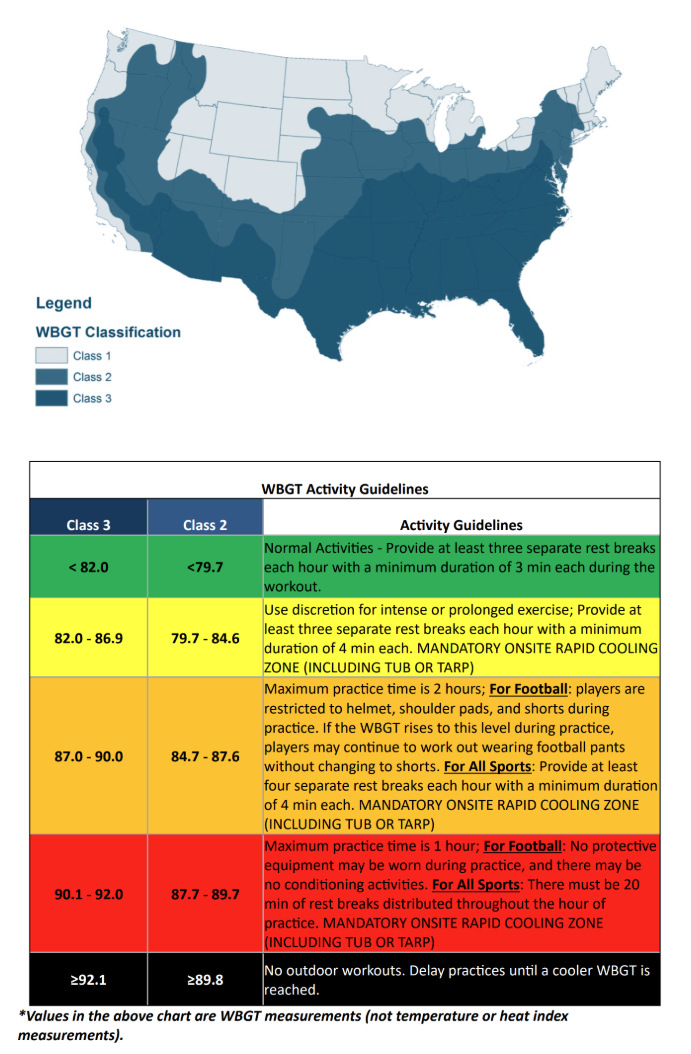
WBGT Means and Methods of Measurement when practices are outside in WBGT of 82 in Class 3 or higher
It is recommended that schools utilize a scientifically approved instrument that measures Wet Bulb Globe Temperature (WBGT) or other scientifically proven method, such as an internet-based weather station software or application, to monitor the wet bulb globe temperature.
If utilizing an on-site instrument, the instrument should be set up 30 minutes prior to practice and should be read 15 minutes prior to the start of practice. If utilizing an internet-based application, the WBGT should also be checked within 15 minutes prior to practice. In both cases, WBGT readings should be taken every 30 minutes during practice.
It is recommended that the same person, if possible, take all readings during a practice timeframe.
When there’s a change in WBGT from one level to the next, responsible modifications to practice activities should be made based on the above WBGT Activity Guidelines.
It is recommended that schools record and keep on file the WBGT temperatures associated for outside practices.
Practices are defined as the time period that a participant engages in a coach/director-supervised, school-approved sport or band conditioning-related activity. Practices are timed from when players report to the outside practice/workout area until the players leave the area.
Emergency Action Plans & Procedures for the Prevention of Heat Related Illness
Each member school’s emergency action plan must include procedures to address heat emergencies that include onsite rapid cooling using cold-water immersion or equivalent means.
Rapid cooling zones must be available for each outdoor athletic and marching band contest, practice, workout, or conditioning session that is held in wet bulb globe temperatures of 82 in Class 3 degrees or higher. Rapid cooling zones are required to have immediate availability of cold-water immersion tubs or tarps that can be filled with ice and water and wrapped around individuals to rapidly cool internal body temperature (TACO method) and are encouraged to include a combination of the following options: ice sponges, towels, water misters, and shade. The presence of an employee or volunteer trained to administer cold-water immersion is recommended.
Coaches and directors must adopt a heat injury prevention philosophy by promoting unrestricted access to water at all times and a student- athlete should never be denied access to water.
Rest breaks must involve unlimited hydration intake and rest without any activity involved.
Competitions & Possible Modifications to Competitions
WBGT practice guidelines and limitations do not apply to UIL competitions, but it is recommended that schools monitor WBGT conditions prior to and during the game and use appropriate emergency action plans for high temperature and humidity. It is advised to consider game time adjustments when experiencing high levels of WBGT readings, in addition to considering use of recommended modifications. Schools may opt to reschedule contests in extreme conditions.
Any contest played in WBGT of 82 in Class 3 degrees or higher must have a rapid cooling zone on site and available at all times to allow for full body, rapid cooling of athletes experiencing heat illness.
It is recommended that additional appropriate and responsible modifications to contests are made as needed to keep participants safe.
Modifications that potentially can be made include (but are not limited to the following):
Potentially using additional strategically placed official timeouts (possibly at 6-minute mark or halfway through each quarter) agreed upon by both coaches and officials prior to the start of the game. This would allow the quick stoppage of play and permit officials, athletes, and coaches to quickly hydrate and cool off.
Alteration of start times as possible to allow for participation in the best conditions possible
Allowing teams that are waiting to warm-up access to air conditioned gyms or locker rooms until organized warm-ups begin.
Consider hydration and fueling strategies for participants on long pregame bus rides.
Unlimited access to cool water.
Shade structures/tents on the sideline to allow for athletes to get out of the direct sunlight.
Fans/Misters to allow for evaporative cooling.
Ice towels/sponges
Lengthening halftimes to allow for more complete cool down and hydration/refueling processes to occur.
Having resources that allow athletes to refuel at halftime by providing appropriate snacks
A modification, in addition to those listed above, for sub-varsity contests, including middle school, may include reducing the length of quarters if agreed upon by both schools.
Cold Weather Procedures
Wind Chill Factor under 29*F (with rain)
A maximum of 60 minutes of continuous exposure.
Coaches must make sure that the athletes are dressed warm.
Wind Chill Factor under 22*F (with rain)
All practices will be indoors.
Wind Chill Factor under 22*F (without rain)
maximum of 60 minutes of continuous exposure.
Coaches must make sure that the athletes are dressed warm.
Wind Chill FactorA under 15*F (without rain)
All practices will be indoors.